
Descrizione
The fascinating remains of one of Tuscany’s most important monasteries
In the Val di Merse, in the territory of Chiusdino, rise the majestic structures of the Abbey of San Galgano, seat of one of the most important Tuscan monasteries erected by the Cistercian order. The latter, established in 1098 in France, in Citeaux (Cistercium in Latin), with the intention of restoring purity to the rule of St Benedict, had spread rapidly in Europe thanks to Bernard of Clairvaux. In their architecture too, the monks reflected the Benedictine precepts, marked by great rigour and simplicity of ornamentation, although declined in the realisation of spectacular constructions
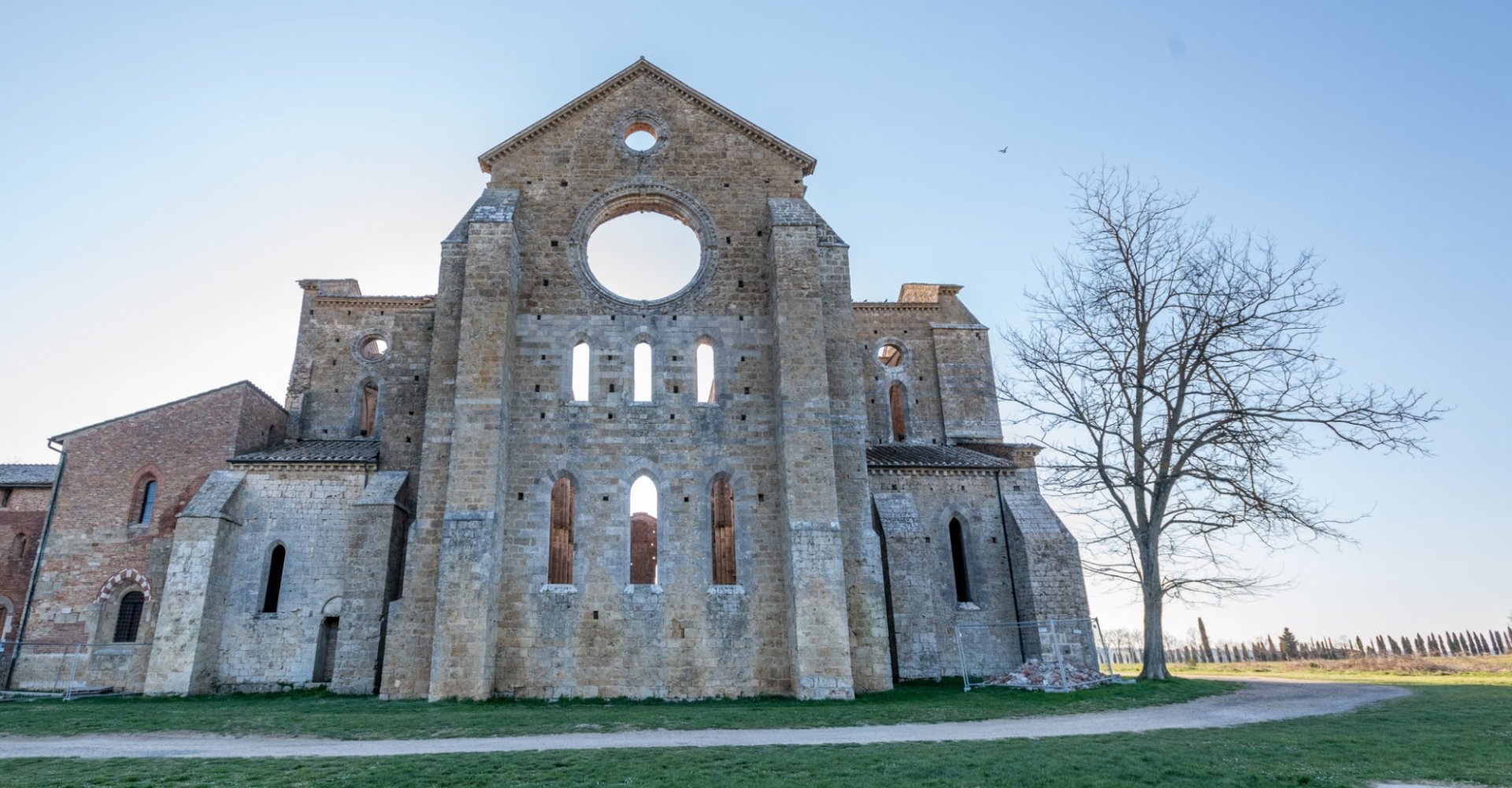
The Abbey, which is devoid of its vaults and roof, dialogues with the nearby and more ancient Hermitage of Montesiepi, built on the site of Galgano’s hermitage.
The earliest record of the Cistercian presence in Val di Merse dates back to 1191, just ten years after the death of the hermit knight from Chiusi. Soon the structures of the original settlement proved insufficient and the monks began the construction of the grandiose abbey in the valley. Construction lasted from 1218 to 1288, but the façade was never completed.
The church is one of the most interesting examples of the Cistercian style straddling the Romanesque and Gothic periods and one of the cornerstones for its spread in Italy.
Between the 13th and 14th centuries, the monks of San Galgano played a key role in the political and economic life of nearby Siena, managing the Biccherna (the office of finance) and directing the work of the cathedral of Siena at the height of its development. By virtue of these new activities and its remote location, the Abbey lost importance and was gradually abandoned. In the 16th century, the church roofs were in ruins and threatened the stability of the crosses, while many windows were broken and the entire complex was in an advanced state of decay. Between the 17th and 18th centuries, in an attempt to revive its fortunes, it was entrusted first to the Vallombrosians and then to the Franciscans, without, however, recovering its former splendour. In 1786, during mass, the bell tower collapsed on the southern transept, destroying the roofs and portions of the complex: the faithful and the monks barely had time to save themselves, and the latter were forced to leave the Abbey and return to Montesiepi.
Over time, the church was stripped of its materials and gradually reduced to a romantic ruin of striking grandeur, while the monastery was adapted to rural uses, with entire wings becoming quarries for building materials.
In the last century, to prevent its definitive collapse, the Italian State, urged by the Municipality of Chiusdino, began its recovery, giving the complex its current appearance. Today, the Abbey is at the centre of a vast programme of research and archaeological excavations that year after year bring to light the remains of the monastery’s lost structures.

